GERMAN AND ITALIAN TRANSLATIONS PLEASE, FIND AT THE BOTTOM OF THIS BLOG
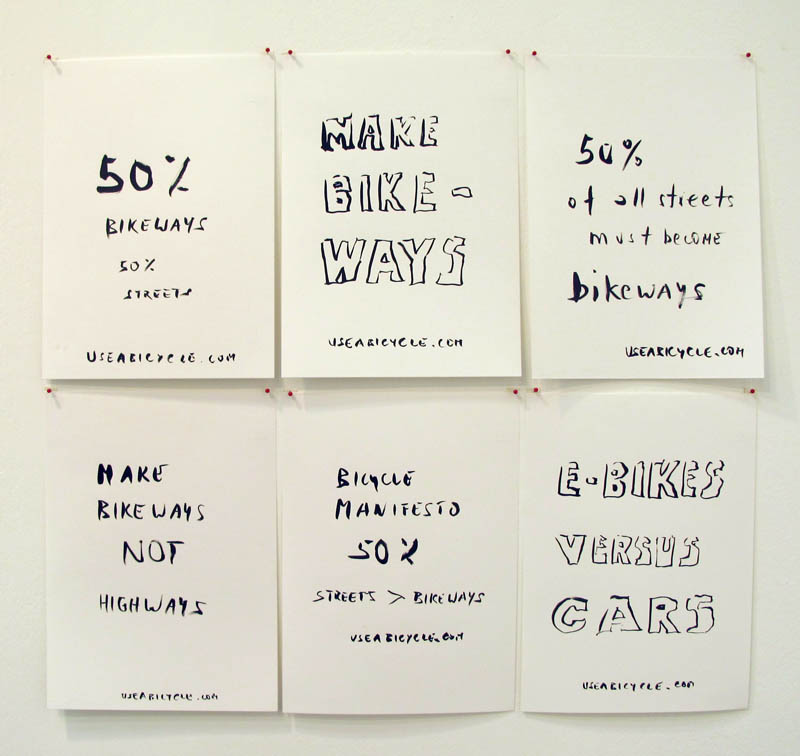
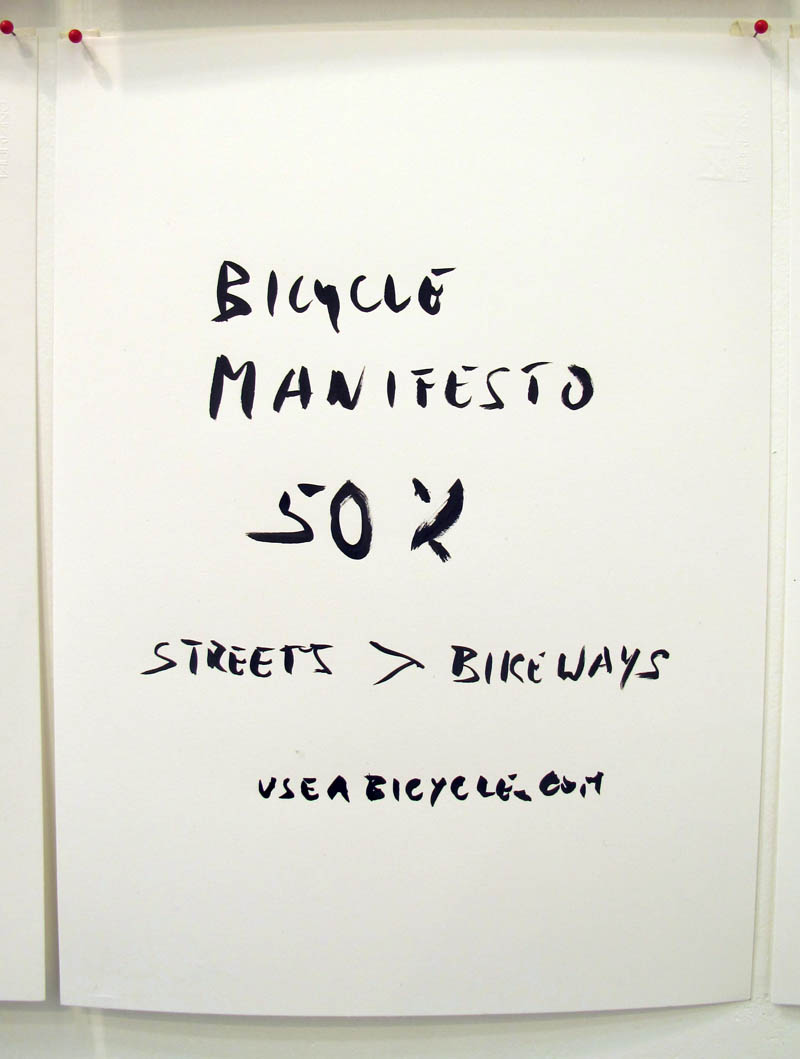
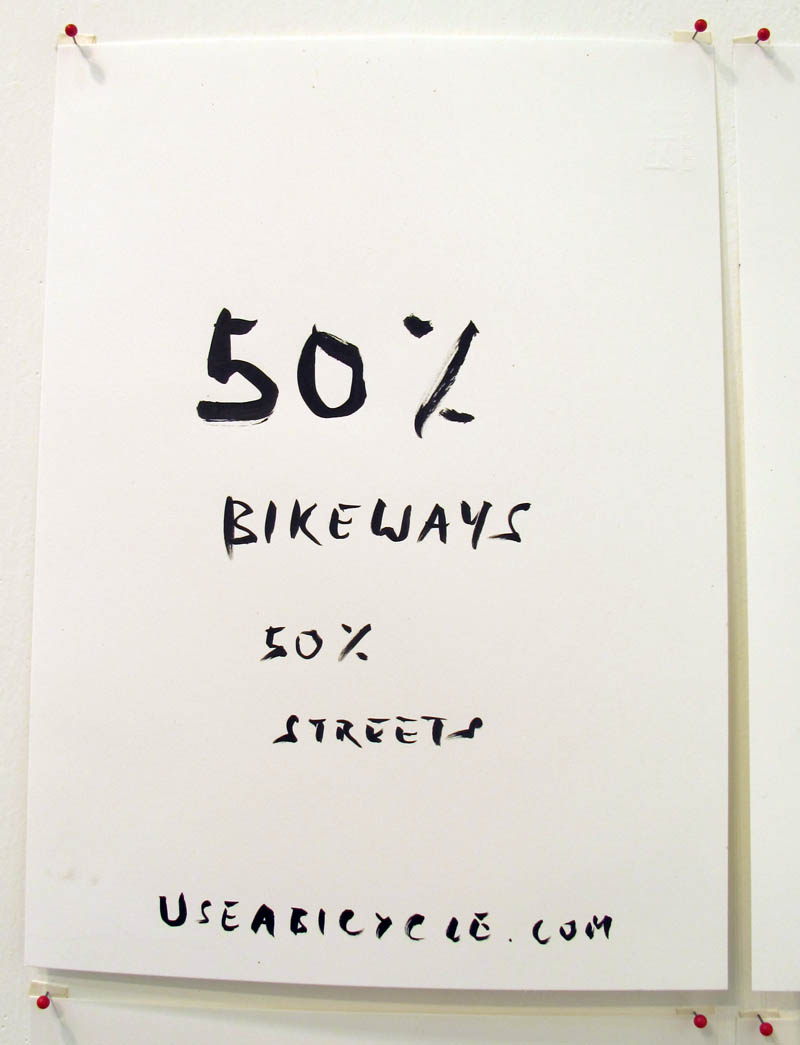
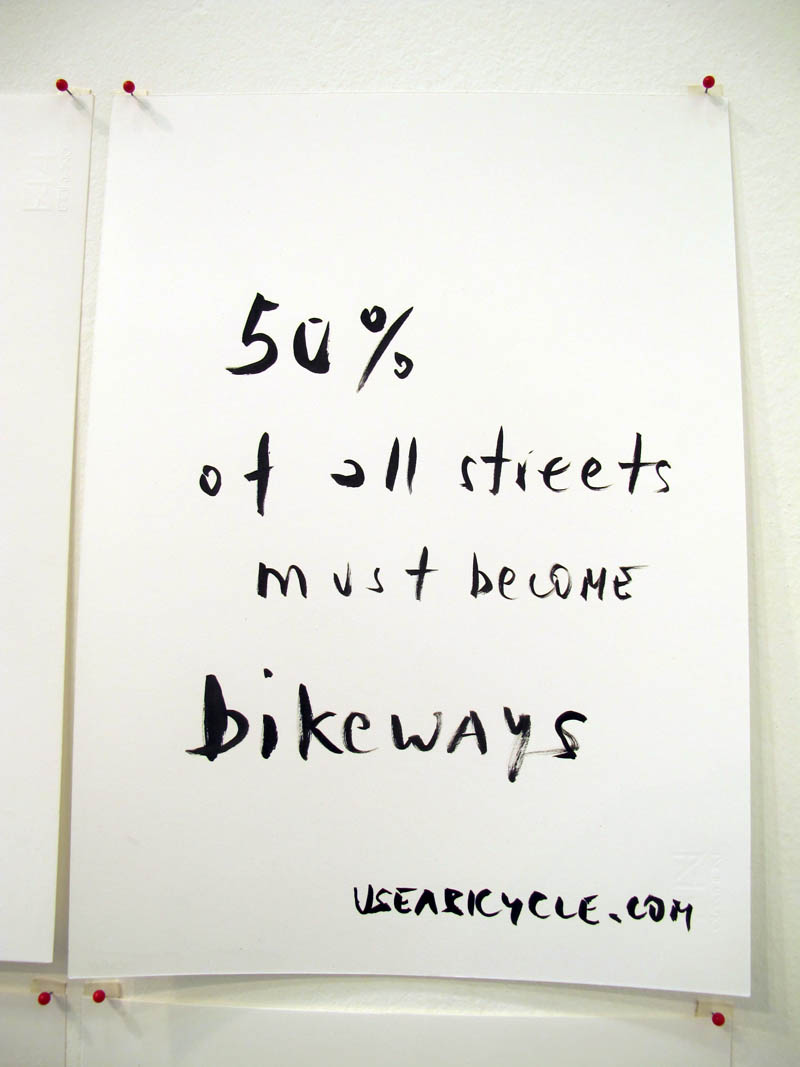
Bicycle Manifesto - 50 percent Of All Streets Need To Be Converted Into Bikeways.
Bicycle Manifesto - 50 percent Of All Streets Need To Be Converted Into Bikeways.
Modern cities were made for cars. Older cities are used as if made for cars, with the exception of small pedestrian zones turned into shopping malls. Nowhere is there space for bicycles.
In recent years, we have seen the introduction of bicycle lanes in certain cities. This is a good start but not enough by far.
What this Bicycle Manifesto demands can be summed up in one sentence: 50 percent of all streets in every city should be reserved for bicycles and electric bicycles. These special lanes should be called bikeways.
Only motorways and pedestrian zones should be exempt from this rule. Motorcycles or scooters that don't run on batteries or exceed the speed of 32 km (20 miles) per hour may not drive on bikeways. Nor are pedestrians allowed.
With this rule, we don't have to ask or beg for more courtesy and respect towards cyclists, and pedestrians don't have to fear bicyclists when they step onto their bike lanes, often built at the expense of sidewalks. Bike lanes don't belong on sidewalks and they shouldn't ornate streets. Bikeways should be like separate street lanes that are clearly separated from car lanes and pedestrian walkways.
Traffic engineering theory has to acknowledge that cyclists (including e-cyclists) are a growing class of species that cannot simply be viewed as lawless fast pedestrians or powerless car drivers.
What are the pros and cons of such a 50 percent solution ?
The introduction of pedestrian zones in the 1960s and 1970s in northern Europe was not an easy imposition. People were too accustomed to driving wherever they wanted, at any time of day. But the reality behind pedestrian zones is that these traffic-calmed urban spaces became open air shopping malls, hence the economic gain justified the inconvenience to traffic.
This shopping mall logic explains why there aren't any significant pedestrian areas in major American cities. Ppedestrian zones sprang up at the same time in nearly every German, Swiss and Austrian city, but the American dream channeled middle class people on newly built highways straight into the suburbs and the shopping malls, ignoring the fact that this triggered the decay of the inner cities.
Given this precedent, what would be gained if existing streets were to be shared with cyclists? For sure, there wouldn't be more shopping than before. There might even be less consumption, since cyclists can't fill up trunks and backseats. But the gain would be a massive improvement in the quality of life, with 50 percent less air pollution, healthier, slimmer and hopefully happier people who would suffer less from strokes, heart attacks and obesity than car drivers.
If cycling were made safer and more efficient, more people would ride their bikes. More cyclists on safe bikeways would in turn encourage others to ride, changing how the city is perceived: people would discover that their cities can easily be crossed by bike.
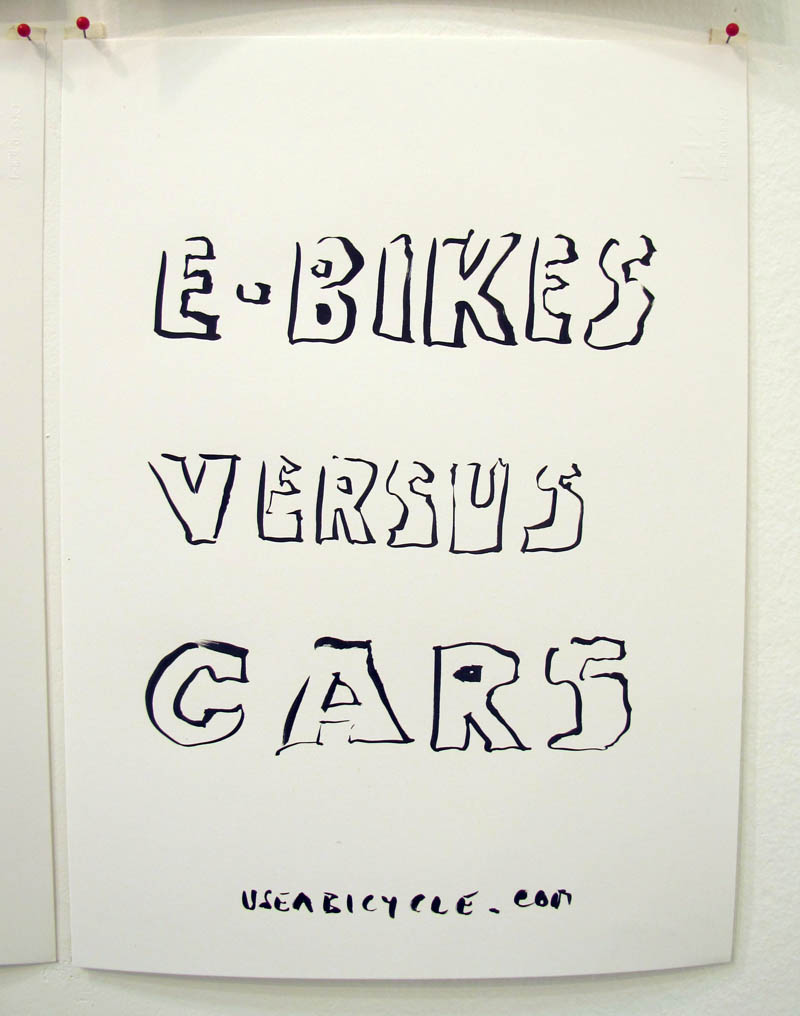
In this context electrical bikes -e-bikes -are not an alternative to bicycles, but an alternative to cars. Car traffic levels would certainly fall and the pattern of transportation would change. Even consumption and cooking habits might change, as small open air markets with fresh and locally produced products could have a renaissance and encourage people to cook differently. In most cities cyclists move as fast or even faster than cars do today.
If bikeways become a reality travel time will be reduced even for cars, since many people will opt for bicycling or e-cycling. The use of e-bikes offers pure biking and/or electrically-assisted cycling which guarantees effortless mobility that can compete with the comfort of heated cars.
Wide bikeways would not only be a solution to the currently most dangerous reality of cycling, but would encourage more people to use their bikes and leave their cars behind.
All this would lead to an improvement in the quality of life, to environmental gains, and to urgently needed changes in urban politics and urban transportation. We need better bike-parking facilities, effective bike sharing concepts, i. e. cheap rent-a-bike networks throughout the city.
Bicycle and tricycle traffic combined with e-bike technology can be made so effective that even the transport of bulky goods, as well as various products and services – taxis, kiosks, etc. – can be offered by bicycle, as is the case in China and in the developing economies. Bicycles are not only very economic and non-polluting modes of urban transportation, but are also very quiet.
If bikeways are implemented and all available streets are shared equally with cars, it would be much easier to cycle in the city. This would guarantee a higher quality of life, thanks to cheap, much healthier and environmentally friendly transportation. Once the infrastructure is in place, a massive rethink will take place and people of all ages and of all physical shapes will resort to bicycles or e-bicycles.
Rainer Ganahl , New York, January 2011
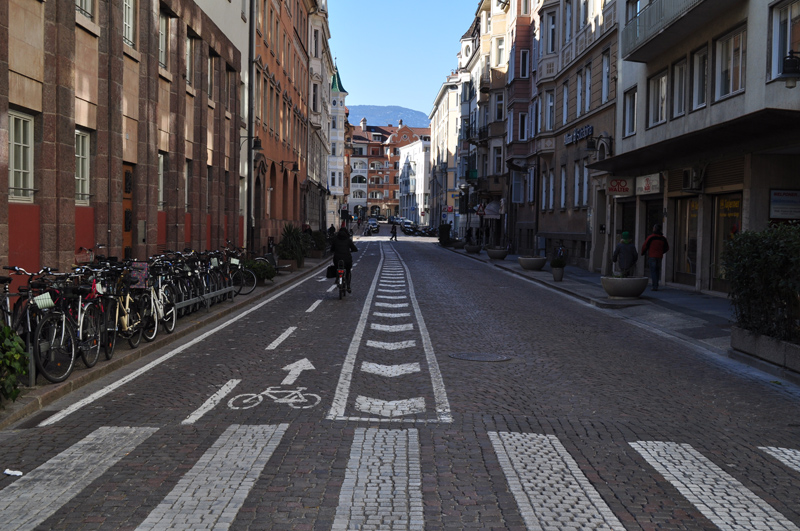
in Bolzano already a reality.. at least for 400 meters
some important technical data on e-bikes taken from the latest NY Times article Gaining a Toehold for the E-Bike By BRAD STONE Published: January 16, 2010
The earliest e-bikes of the 1990s got about 15 miles on a single charge. The Eneloop’s battery can power the bike about 46 miles before it needs to be plugged into an outlet and recharged for around three hours; it also partially recharges when the rider brakes or coasts downhill.
The federal government resolved the legal obstacle with legislation in 2002, classifying any two-wheel, pedal-driven bike with a maximum speed of 20 miles an hour as a bike, which does not need turn signals or licensed riders.
In the 1990s, ....Their bikes had heavy steel frames and the same lead acid batteries used in automobiles, which themselves could weigh 80 pounds. The entire Eneloop weights about 50 pounds.
This manifesto is open for suggestions and discussions:
just email me: useabicycle @ yahoo.com
I AM DISCUSSING THE CONTENT AND DEMANDS OF THIS MANIFESTO IN BOLOGNA WITH ITALIAN POLITICIANS AND THEORETICIANS AS PERFORMANCE (january 2011)
MORE DISCUSSIONS ARE TO BE HOLD - PLEASE MAKE THESE DISCUSSIONS HAPPEN FOR A BETTER WORLD
Johan Hartle: 1/12/2011
Das Manifest ist schön. Klingt sehr ernst. Ich denke mal darüber nach, ob mir etwas ("im Ton Angemessenes") dazu einfällt. Noch klingt es etwas nach Bürgerinitiative (sorry).
(translation by RG: the manifesto is nice. sound very serious. I m thinking about it whether I can say something appropriate. So far, it sound somehow civil actionism /citiicens' initiative(sorry)
my answer (rainer ganahl)
It should be pointed out that futurism can be now and doesn’t have to be funny, aggressive, or pure poetry. This manifesto proposes peaceful solutions in a non-poetic way, not pataphysical or imaginary solutions laid out in the style of Alfred Jarry, a big poet and biker which whom I identify or in the manner Marinetti did - adoring war and destruction... Times will come where cyclists don't have to resort to anger when it comes to unfortunate incidents with cars because of failed urban politics. Marinetti's writing inspired the futurist artist Boccioni to make the painting cyclist - a high speed racer, most likely on performance enhancing drugs - provided as well by Alfred Jarry (Perpetual Motion Food). This bicycle manifesto is not into speed but into questions of conviviality (sustainability and traffic solutions. It is the opposite of what a Futurist Manifesto wants. But interesting enough in 1908, Marinetti was involved in a small car accident, after trying to avoid two cyclists on a road just outside Milan. ... that made him so angry that he sees war as they only 'human hygiene'. He went on Futurism "will glorify war - the world's only hygiene - militarism, patriotism, the destructive gesture of freedom-bringers, beautiful ideas worth dying for, and scorn for woman.”
Brad Alexander 1/14/2011
hey rainer,
clearly the text comes across as highly utopian, not necessarily naïve of course, but there are a few things lacking.
my question is, how do you make the decision WHICH urban problems need to be, and can be, solved by the transition to bike lanes. How did you decide which issues you would like to address in this manifesto? This assumes, in a somewhat non-scientific analysis, that were 50% of auto-streets to be turned into bikeways, half of the normal traffic would need to be either diverted or not exist. This 50% decrease of auto-traffic leaves 50% of its population in a position to ride a bike. What happens to that remaining population, stranded, if they are unable to ride a bike... perhaps too old, handicapped in some way, for some reason unable to ride a bike...
could there exist some form of bicycle public transportation?
this isn't a critique of the manifesto, so i write it half-jokingly, but it occurred to me that half the population might be left "stranded" if they cant ride a bike, which makes me think about some form of bicycle public service/transportation. just a thought.
i imagine that in the discussion in bologna, skeptics might ask about specific situations which would require you to solve something that you might not be interested in... it might be helpful to make more clear the function, and guidelines or boundaries of exactly what such a manifesto should address. being more clear about the aims and interests of the idea, as to avoid questions which would make the discussion become annoying or nit-picky or less exciting.
my answer (rainer ganahl)
many thanks for your answer. Let me answer point by point: Which issue do I want to address: clearly - the bikeway issue. a special protected area reserved for bicycles only. all other effects on urban politics is conseuqential. will follow. I only mentioned shopping attitude and health issues.
your second point addresses the concern what to do with the rest of 50 % percent of cars that don t properly fit in the streets anymore due to 50 % shrinking space for car ? Nothing ! they would hopefully stay at home, stay away or also convert to cycling. as I mentioned above. A lot of people would convert to cycling should there be viable options and securte bikeways. Also, as I pointed out, electric bicycles are not ment to be an alternative to traditional bicycles but to cars and public transport. simply speaking, when it boils down to convinience the bike should become the better and cheaper option than a fuel based car.
As mentioned I do also address the probabilty of 3 wheeled electric taxis if they don t exceed 32 km (20 miles)an hour. but don t forget, when we get to a point where regular cars become under attack and more and more looking like a bad option we will also see more flexibilities in public transportation that also is already about to go electric. but they can drive on regular streets.
last but not least, I just saw again the film De Sicas classic Bicycle Thieves and what is surprising is that we barely saw car on the streets but lots of bicycles. At that time., it was looked at as a sign of poverty but today it can be looked at as a smart and intelligent option and hopefully makes car drivers look a bit ackward. don't forget. since the urban professional and creative class embraces again the city and wants to live in the center -- and not anymore in the fancy suburbs - cars look really suburban, provincial, far out of the center. And that is somehowalso an effect that can be used to inspire people to use bicycles. Bikes are cool.
ASKED ABOUT THIS MANIFESTO IN RELATIONSHIP TO MY EXHIBITION AT TRESOR /KUNSTFORUM, VIENNA 2012
Seit meiner fruehen Kindheit fahre ich mit dem Fahrrad. Ich war selbst in Großstädten wie Paris und New York mit dem Fahrrad unterwegs, bevor sie peu à peu fahrradsicher gemacht wurden. Paris ist das beste Beispiel für die Konsequenzen verantwortungsvoller urbaner Politik, die in relativ kurzer Zeit eine Stadt ohne Fahrradwege in eine fahrradfreundliche Metropole verwandelte. Als Kleinkind konnte ich auch die Einführung verkehrsfreier Stadtzonen direkt miterleben. Aus Durchfahrtsstraßen wurden Einkaufszonen für Fußgänger.
Ich weise deshalb auf diese massiven Veränderungen in der Vergangenheit hin, weil wir in diesem Prozess der Anpassung unserer Stadträume an die natürlichen Bedürfnisse des Großteils der Bevölkerung nicht innehalten dürfen. Der Stadtraum sollte nicht unterbesetzten Autos angepasst sein, sondern Fußgängern, (e)Fahrradfahrern und öffentlichen Verkehrsteilnehmern.
Aus genau diesem Grunde habe ich das Fahrradmanifeseto geschrieben, das es sich zum Ziel macht, 50 % der Stadtstraßenfläche in Fahrradwege zu konvertieren. Da das Fahrrad ein Hauptthema meiner Ausstellung im Tresor ist, und ich mich mit Fahrrädern in der Kunst seit über 10 Jahren beschäftige, finde ich eine öffentliche Diskussion meines Fahrradmanifestos für nicht nur sinnvoll, sondern auch für notwendig. Der Hauptprotagonist meiner Ausstellung, Alfred Jarry starb mit kaum über 30 Jahren nur kurz vor dem Erscheinen der Manifesti der Futuristen, die ebenfalls politische und gesellschaftliche Veränderungen forderten. Im Gegensatz zu den Futuristen geht es mir nicht um die Verherrlichung von Krieg, Aggression, Ungerechtigkeit, Geschwindigkeit, Jugend und Technik, sondern nur um eine gerechte, aber folgenschwere Umverteilung der Verkehrsprioritäten im Stadtraum.
Marinetti, geboren in Allexandria und verwickelt in die italienischen Kolonialkriege in Lybien, war auch ein überzeugter Ideologe des italienischen Faschismus, ein enger Freund von Mussolini und ein expliziter Befürworter von Krieg und Zerstörung bis in sein Todesjahr 1944. Gemäß Marinetti hätte der Futurismus die Staatskunst von Italien unterm Faschismus werden sollen. Interessanterweise bespricht der Autofahrer Marinetti schon in seinem Manifesto von einer Konfrontation mit zwei Fahrradfahrern, die in einem Unfall mit seinem Wagen endete. Damit eben genau solche Konfrontationen sich erübrigen, spricht mein Fahrrad Manifesto sich für die gerechte und friedliche 50 % Teilung des Straßenraumes aus.
Die Rückschau auf Alfred Jarry in der Austellung „I wanna be Alfred Jarry“ ist keine nostalgische Abwendung von der Gegenwart, sondern ist ein Abtasten auf uneingelöste utopische Gehalte in den Anfängen der künstlerischen, technischen und politischen Avantguarde um die Wende ins 20. Jahrhundert.
Mein Fahrradmanifesto steht direkt in Bezug zur Tresor Ausstellung, zu einer Kunst, die keine Angst vor dem Leben kennt und zur Geschichte der futuristischen Manifesti, die nicht völlig unabhängig von der Literatur von und den Publikumseklat um Alfred Jarry sind. Dennoch sollte aber eine Verlesung und eine Diskussion meines Fahrradmanifestos sich vorwiegend um die Inhalte diese Manifestos kümmern und sinnvolle Stadtpolítik fordern.
Rainer Ganahl, New York, 26. Februar 2012
---------------------------------------------------------------------------------------------------------------------------------------------------------------------------------------------------
useabicycle.com
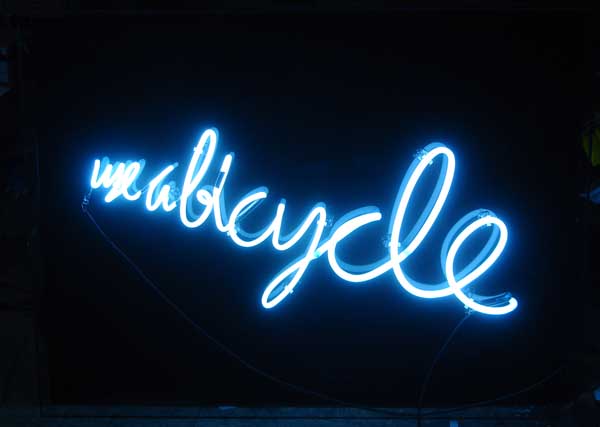
neon, 2006
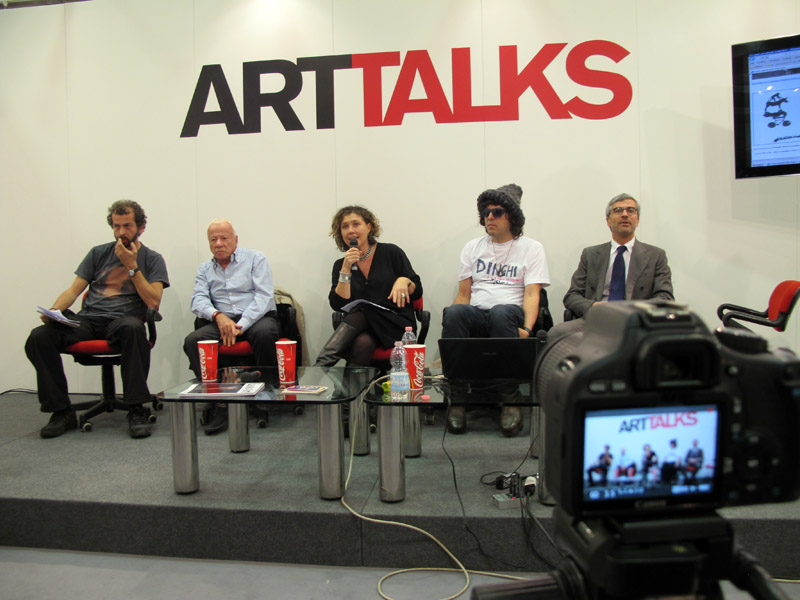
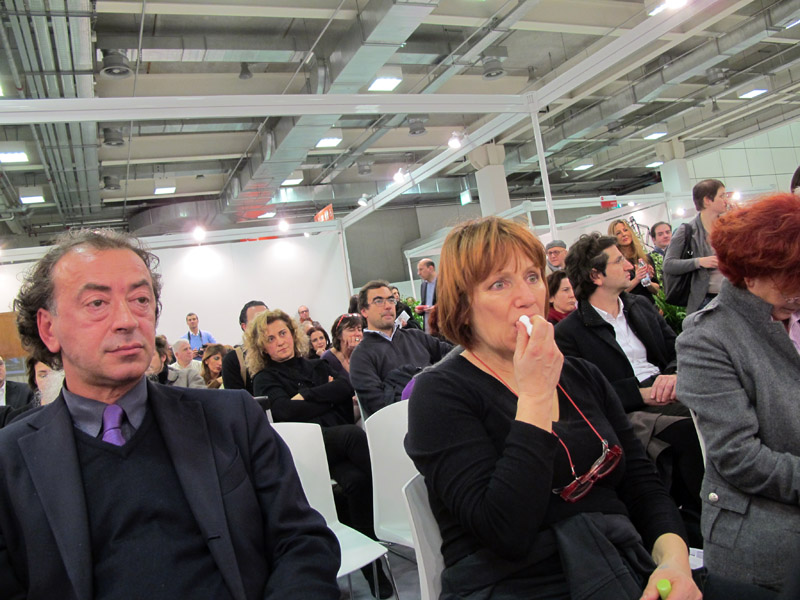
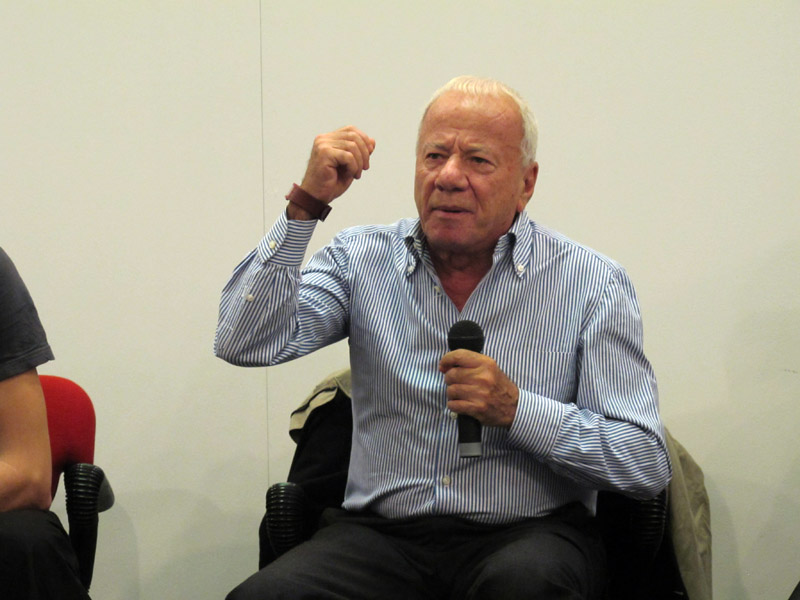
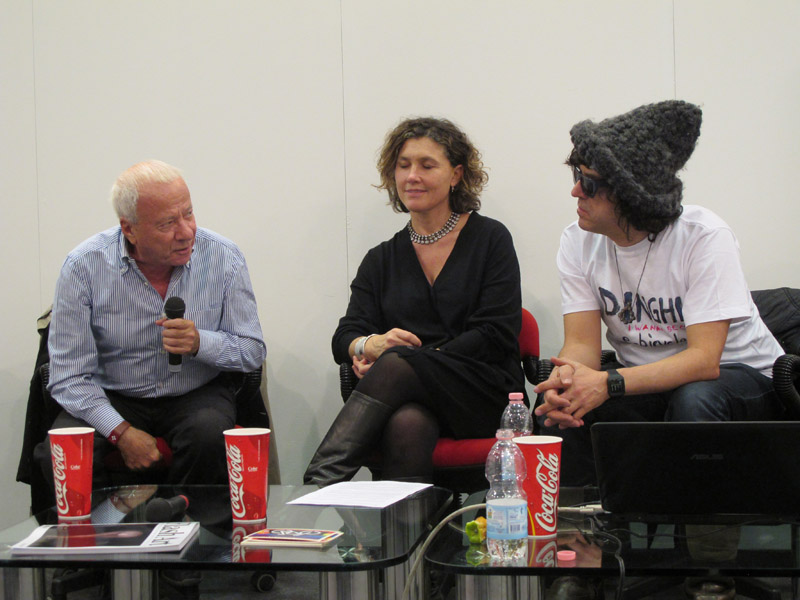
discussion in bologna of my bicycle manifesto
with Luca Conti, Bonito Oliva, Cristiana Perella, me (Rainer Ganahl),
GERMAN TRANSLATION BY LISA KREIL:
Die Revolution steht bevor...
Fahrrad Manifest – 50% aller Straßen müssen in Bikeways umgewidmet werden
Moderne Städte wurden für Autos gemacht. Ältere Städte werden benutzt als wären sie für Autos gemacht worden, mit Ausnahme kleiner Fußgängerzonen, die in Einkaufspassagen umgewandelt wurden. Fahrräder haben nirgends Platz.
In den letzten Jahren wurden in einigen Städten Radwege eingeführt. Das ist zwar ein guter Anfang, genügt aber noch lange nicht.
Was dieses Fahrrad Manifest verlangt, kann in einem Satz zusammengefasst werden: 50% aller Straßen in jeder Stadt sollen den Fahrrädern und elektrischen Fahrrädern vorbehalten sein. Diese Straßen sollen Bikeways genannt werden.
Nur Autobahnen und Fußgängerzonen sollen von dieser Regelung ausgenommen werden. Motorräder oder Roller ohne elektrischen Antrieb oder die eine Geschwindigkeit von 32 km/h überschreiten (20 Meilen) dürfen nicht auf Bikeways fahren. Auch Fußgänger sind dort nicht erlaubt.
Mit dieser Regelung fragen oder bitten wir nicht um mehr Anerkennung und Respekt den Radfahrern gegenüber. Fußgänger müssen nicht länger Angst vor Radfahrern haben wenn sie die Radwege betreten, die oftmals auf Kosten von Gehsteigen gebaut werden. Radwege gehören nicht neben den Gehsteig and sollen keine Straßen schmücken. Bikeways sind wie separate Straßenspuren zu behandeln und sind klar von Autospuren und Bürgersteigen zu trennen.
Das öffentliche Verkehrsmanagement muss sich darüber bewusst werden, dass Radfahrer (und E-Bike-Fahrer) eine wachsende Gruppe innerhalb der Bevölkerung sind, die nicht einfach als „gesetzlose schnelle Fußgänger“ oder „machtlose Autofahrer“ abgetan werden kann.
Was sind die Vor- und die Nachteile dieser 50%-Regelung?
Die Einführung von Fußgängerzonen in den 1960-er und 1970-er Jahren in Nord-Europa gestaltete sich als schwierig. Die Leute waren zu sehr daran gewöhnt, zu jeder Zeit überall hin mit dem Auto zu fahren. Die Realität hinter diesen Fußgängerzonen ist, dass sich die verkehrsberuhigten Stadtteile zu Freiluft-Einkaufszentren entwickelten, daher rechtfertigte der wirtschaftliche Zuwachs die verkehrstechnischen Unannehmlichkeiten.
Diese Einkaufszentrum-Logik erklärt die Tatsache, dass es in amerikanischen Großstädten keine nennenswerten Fußgängerzonen gibt. Zur gleichen Zeit kamen in jeder deutschen, schweizerischen und österreichischen Stadt Fußgängerzonen auf, der amerikanische Traum hingegen führte die Mittelschicht auf neu gebauten Autostraßen direkt in die Vorstädte und zu den Einkaufszentren ohne der Tatsache Bedeutung zu schenken, dass damit der Niedergang für die Innenstädte begann.
Vor diesem Hintergrund ist die Frage zu stellen, was man gewinnen würde, wenn bereits bestehende Straßen mit Radfahrern geteilt werden würden? Ganz sicher würden die Leute deswegen nicht vermehrt einkaufen. Es würde vielleicht sogar zu weniger Konsum kommen, weil Radfahrer über keinen Kofferraum verfügen, den sie befüllen können. Aber der Gewinn wäre eine massive Verbesserung der Lebensqualität mit 50% weniger Luftverschmutzung, gesündere, schlankere und hoffentlich auch glücklichere Menschen, die weniger unter Schlaganfällen, Herzinfarkten und krankhaftem Übergewicht leiden als Autofahrer.
Wenn Radfahren sicherer und effizienter gemacht werden würde, würden mehr Menschen Fahrrad fahren. Mehr Radfahrer auf sicheren Bikeways wiederum würden immer mehr Menschen anregen, auch Rad zu fahren wodurch sich die Wahrnehmung der Stadt verändert: Die Menschen würden entdecken, dass ihre Städte einfach mit dem Rad durchmessen werden können.
Elektrische Fahrräder – E-Bikes – sind in diesem Zusammenhang keine Alternative zu Fahrrädern sondern zu Autos. Der Autoverkehr würde sicherlich reduziert und Transportmuster verändert werden. Sogar Konsum- und Koch-Gewohnheiten könnten sich wandeln, weil kleine Märkte mit frischen, regionalen Produkten wieder mehr Bedeutung erlangen würden, die die Menschen anregen, anders zu kochen. In fast allen Städten bewegen sich die Radfahrer heute genau so schnell oder sogar schneller als die Autos.
Wenn Bikeways Wirklichkeit werden, werden auch die Fahrzeiten für Autos reduziert, weil sich viele Menschen für Radfahren oder E-Bike fahren entscheiden würden. Mit einem E-Bike kann man klassisch Rad fahren und/oder elektrisch unterstützt Rad fahren, was wiederum Mobilität ohne jede Anstrengung bietet und sich so durchaus mit dem Komfort eines beheizten Autos vergleichen lässt.
Großzügige Bikeways wären nicht nur ein Ausweg aus der gegenwärtig überaus gefährlichen Radfahr-Realität sondern auch eine Einladung an die Menschen, das Fahrrad zu benutzen und das Auto stehen zu lassen.
All dies würde die Lebensqualität erhöhen, zu Verbesserungen der ökologischen Situation und zu dringend notwendigen Veränderungen in der Stadt-, Verkehrs- und Transportpolitik führen. Wir brauchen bessere Fahrradabstell-Möglichkeiten, nachhaltige Bike Sharing-Ideen, zum Beispiel ein kostengünstiges städtisches Fahrradverleih-Netzwerk.
Fahrrad und Dreirad-Verkehr kombiniert mit E-Bike Technologie kann derart effizient gemacht werden, dass sogar der Transport von sperrigen Dingen sowie diverse Servicedienstleistungen – wie etwa Taxis oder Kioskbetriebe etc. – via Fahrrad angeboten werden können, wie es bereits in China und in den Ländern der „neuen Märkte“ der Fall ist. Fahrräder sind nicht nur ein günstiges und ein umweltfreundliches Fortbewegungsmittel im städtischen Verkehr sondern sie produzieren auch keinen Lärm.
Wenn Bikeways eingeführt und die verfügbaren Straßen zwischen Rad- und Autofahrern geteilt werden würden, wäre es viel einfacher, in der Stadt Fahrrad zu fahren. Dies würde – dank eines kostengünstigen, viel gesünderen und umweltfreundlichen Transportmittels – eine höhere Lebensqualität gewährleisten. Wenn die Infrastruktur einmal zur Verfügung gestellt ist, wird ein massives Umdenken stattfinden und Menschen allen Alters und in jedweder körperlicher Verfassung werden auf Fahrräder oder E-Bikes umsteigen.
Rainer Ganahl, New York, Jänner 2011
-------------
MANIFESTO DELLA BICICLETTA - ARRIVA LA RIVOLUZIONE
il 50 % di tutte le strade si convertirà in ciclopiste
Le città moderne sono state fatte per le macchine. Le città più vecchie no, ma vengono usate come se così fosse, tranne alcune zone pedonali convertite in centri commerciali. Nessuna delle due tipologie urbane accoglie le biciclette.
Negli ultimi anni in certe città si è vista l’introduzione di piste ciclabili. Questo è un buon inizio ma non è affatto sufficiente.
Quello che il Manifesto della bicicletta richiede si può riassumere in una frase: il 50% di tutte le strade di tutte le città dovrà essere riservato alle biciclette e alle biciclette elettriche. Queste piste speciali si dovrebbero chiamare ciclopiste.
Solo le autostrade di alta velocità e le zone pedonali dovrebbero essere esenti da questa regola. Le motociclette o motorini che non funzionano a batteria o che eccedono la velocità di 32 km (20 miglia) all’ora non dovrebbero circolare sulle ciclopiste. Né si dovrebbe permettere l’accesso a pedoni.
Con questa regola non c’è bisogno di chiedere o supplicare la cortesia o il rispetto verso i ciclisti e allo stesso tempo i pedoni non devono avere paura delle biciclette quando mettono piede sulle loro piste, spesso rubate dal territorio pedonale. Le piste ciclabili non appartengono ai marciapiedi e non dovrebbero adornare le strade. Le ciclopiste dovrebbero essere come corsie stradali chiaramente separate dalle corsie automobilistiche e dai marciapiedi pedonali.
La teoria dell’ingegneria del traffico deve riconoscere che i ciclisti (incluso gli e-ciclisti) sono una specie in aumento che non possono essere visti né come pedoni veloci senza legge né come autisti impotenti.
Cosa si guadagnerà e cosa si perderà con una tale soluzione al 50%?
L’introduzione di zone pedonali negli anni 60 e 70 nel nord dell’Europa non fu un’ imposizione facile. La gente era troppo abituata a poter guidare dappertutto e in qualsiasi momento del giorno, ma la realtà dietro gli spazi pedonali è che queste zone di città senza traffico diventarono centri commerciali all’aperto, dando quindi un guadagno economico che giustificò il disturbo al traffico.
Questa logica del centro commerciale spiega perché non ci sono delle zone pedonali rilevanti nelle grandi città americane: mentre spuntarono zone pedonali in quasi tutte le città tedesche, svizzere e austriache, nello stesso periodo il sogno americano portò la classe media sulle nuove autostrade alle periferie proprio accanto agli shopping mall, senza prestare particolare attenzione ai centri di città ormai in decadenza.
Considerando questo precedente, cosa si guadagnerebbe se le strade già esistenti dovessero essere suddivise e condivise con i ciclisti? Di certo non si potrebbe più fare shopping, e forse ci sarebbe ancora meno consumo visto che i ciclisti non hanno un portabagagli o sedile posteriore da poter riempire, ma il guadagno sarebbe un enorme miglioramento della qualità della vita con un 50% in meno di inquinamento e con gente più sana, magra e si spera più felice, che soffre meno di ictus, infarti e obesità.
Se il ciclismo diventasse più sicuro e più efficiente, più gente andrebbe in bicicletta; più sono i ciclisti su ciclopiste sicure, più gente avrebbe il desiderio di prendere la bicicletta. In questo modo si cambierebbe la percezione della città, scoprendo che può essere attraversata facilmente in bicicletta.
Considerando ciò, le biciclette elettriche – le e-bici – non sono quindi un’alternativa alle biciclette ma un’alternativa alle macchine. Il traffico automobilistico di certo diminuirebbe e il modello di trasporto urbano cambierebbe. Anche il consumo e i costumi alimentari potrebbero cambiare giacché si vedrebbe una rinascita di piccoli mercati all’aperto con prodotti freschi della zona invitando così alla gente a cucinare in modo diverso.
In molte città le biciclette si muovono con la stessa velocità delle macchine o addirittura più velocemente. Se le ciclopiste diventassero una realtà, i tempi di tragitto si ridurrebbero visto che molti sceglierebbero le biciclette o le e-bici. L’uso delle e-bici offre sia ciclismo puro sia ciclismo assistito elettricamente che può garantire una facile mobilità capace di competere con la comodità delle macchine con riscaldamento.
Ciclopiste generose non solo offrirebbero un’alternativa all’attuale realtà ciclistica, spesso pericolosa, ma sarà anche un invito a scendere in strada a chi non usa la bici e anche uno stimolo agli autisti a lasciare la macchina.
Tutto ciò porterebbe a un sicuro miglioramento della qualità della vita, a un guadagno ambientale e a dei cambi ulteriori alla politica urbana e al trasporto urbano che hanno molto bisogno di essere implementati. Abbiamo bisogno di migliori parcheggi per le biciclette, di bike-sharing e di reti di noleggio di biciclette a buon prezzo in tutta la città.
Il traffico di biciclette e tricicli combinato con la tecnologia delle e-bici si può fare in modo talmente efficace che anche i servizi di grande volume (taxi, piccoli commerci, ecc.) si potranno offrire in bicicletta come accade in Cina e in altri paesi dove si incontrano economie sviluppate e quelle in via di sviluppo. La bicicletta inoltre non è solo un mezzo di trasporto economico che non inquina, ma è anche molto silenzioso.
Con l’implementazione di ciclopiste che condividono con le macchine tutte le strade disponibili, una mobilità agevole in bicicletta garantirebbe una vita più facile grazie a un trasporto economico, molto più sano e che rispetta l’ambiente. Una volta che l’infrastruttura sia implementata, le abitudini cambieranno naturalmente e le persone di tutte le età e di tutte le forme fisiche faranno riscorso alla bicicletta o alla e-bicicletta.
Rainer Ganahl, New York, 25 gennaio 2011
useabicycle.com
translation: Cristiana Perrella
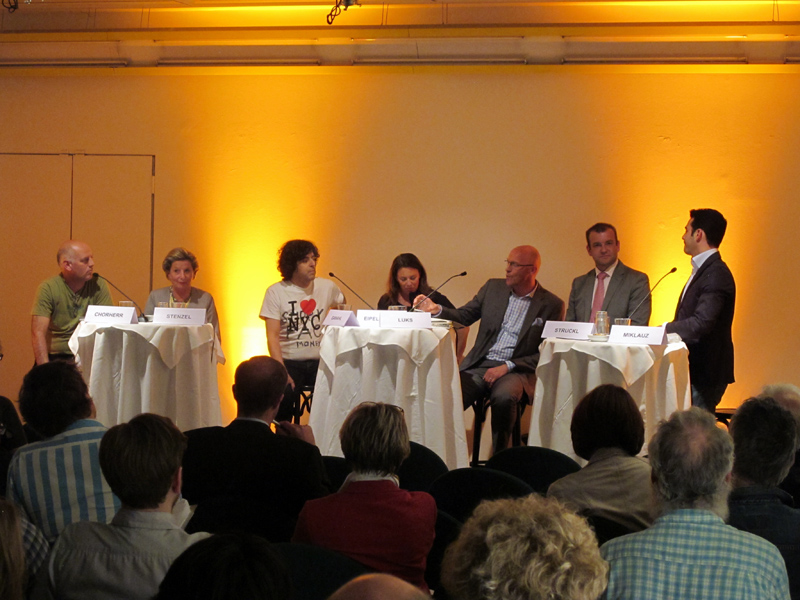
Die Tangente als Fahrradweg? Diskussion zur urbanen Mobilität 9.5.2012, 19.30 Uhr
TeilnehmerInnen: Rainer Ganahl (Künstler), Christoph Chorherr (Gemeinderat und Landtagsabgeordneter
in Wien, Die Grünen), Fred Luks (Nachhaltigkeitsmanager Bank Austria UniCredit Group),
Alexander Martinovsky (Vorstand, Wiesenthal Gruppe), Ursula Stenzel (Bezirksvorsteherin
Innere Stadt), Heike Eipeldauer (Kuratorin der Ausstellung)
lislten to the discussion.. mpr3 sound file